






The Short Answer on Bathroom Fan Codes
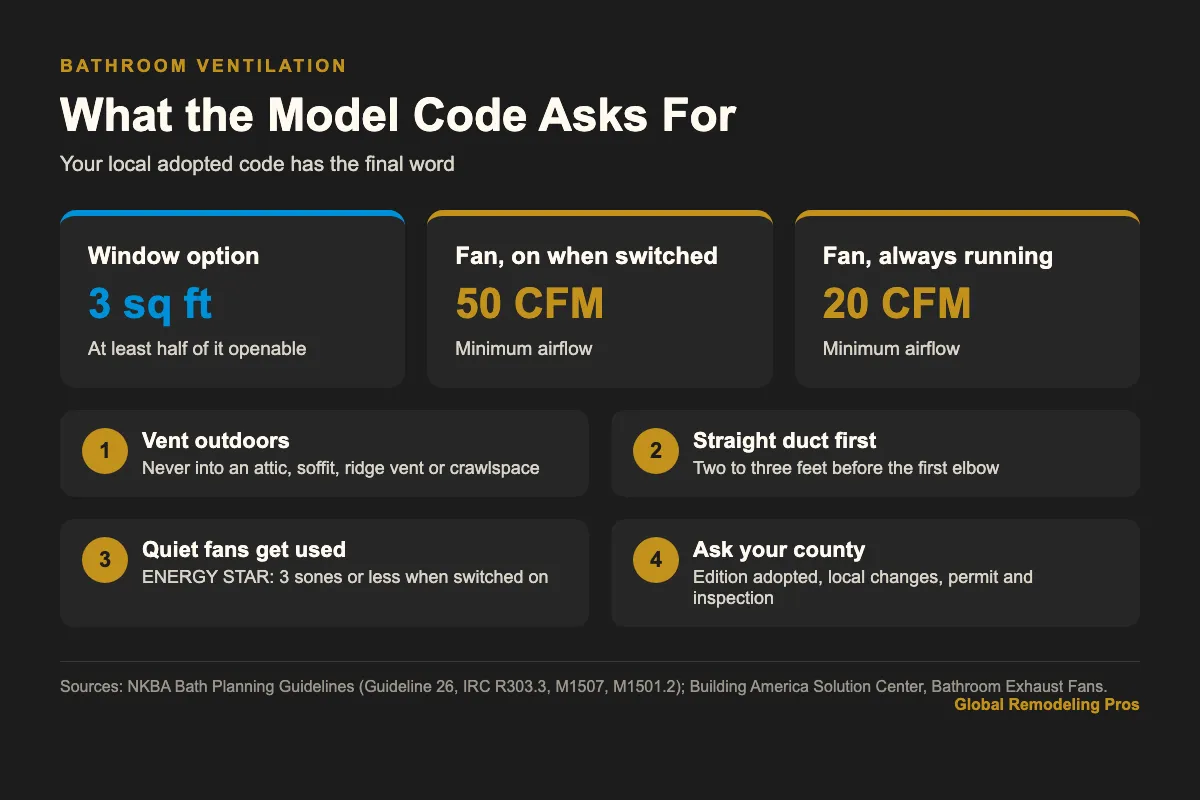
A bathroom exhaust fan is required by code unless the room has a window that meets size rules. The NKBA Bath Planning Guidelines summarize the model code. You need a window of at least 3 square feet with half of it openable. Without that window, you need a fan of at least 50 cubic feet per minute vented outside.
That is the model code. Your city or county enforces its own adopted version, which may add local changes.
This explainer covers code editions, the window exception, fan size and venting, and what to ask your building department. Planning a remodel? See our bathroom remodeling page.
Code Editions and Local Adoption
Most US homes are built under a version of the International Residential Code, or IRC. The ICC updates it every three years. States and local governments then adopt an edition, sometimes with their own changes.
That means the rule in one county can differ from the next. In Maryland, for example, the state requires each jurisdiction to use the same edition of the IRC under the Maryland Building Performance Standards.
Why the edition matters
Ventilation numbers have stayed fairly steady across recent editions, but details and exceptions can shift. Always check the edition your local office enforces.
Remodels vs. new builds
Code usually applies to the work you do. If a remodel opens walls or ceilings in the bathroom, adding a proper fan is often required or strongly advised.
This article is general guidance, not legal advice. Your building department has the final word.
A local code can be stricter than the model code. Some places may require a fan even when a window is present, which is why the local office matters.
Older homes are often built before current rules. They are not always required to update right away, but a remodel is a natural time to bring ventilation up to today’s standards.
Window Exception vs. Mechanical Ventilation
Under the model code summarized in the NKBA guidelines, a bathroom can use natural ventilation. The window must have at least 3 square feet of glass, and at least half of that must open.
If the window is too small, does not open, or the bathroom has no window, a mechanical fan is required.
The Building America Solution Center lists the fan sizes. A fan that runs when switched on needs at least 50 cubic feet per minute. A fan that runs all the time needs at least 20.
Why many pros install a fan anyway
A window only helps when someone opens it. Few people open a window in January. The NKBA recommends a mechanical exhaust system vented outside for each enclosed area, even when a window is present.
Controls help the fan do its job. A timer switch keeps the fan running after you leave. A humidity-sensing fan turns on by itself when the room gets steamy. Both help clear moisture fully.
Venting Outdoors and Getting the Size Right
Where the air goes matters as much as the fan. The code cited in the NKBA guidelines says exhaust air must go outdoors. It cannot be dumped into an attic, soffit, ridge vent or crawlspace.
A fan venting into the attic moves the moisture problem somewhere you cannot see. The Building America Solution Center also advises two to three feet of straight duct from the fan before the first elbow. It prefers smooth rigid metal duct over flex duct.
Noise and efficiency
A quiet fan gets used. ENERGY STAR fans are rated at 3 sones or less for fans that run when switched on, according to the same guide.
Good ventilation protects the whole room. The EPA recommends keeping indoor humidity below 60 percent, and says running a fan helps prevent mold from coming back.
Global Remodeling Pros is a family owned remodeler founded in 2017, with more than 5,000 completed projects across Maryland and the DMV. We are MHIC licensed and insured. When a remodel opens the ceiling, that is the easiest time to add or upgrade a fan and duct it outside. Every project is backed by our lifetime labor guarantee.
Place the fan where the steam is. In most bathrooms, that means near or over the shower or tub, not over the door. A fan placed far from the shower moves dry air and leaves the damp air behind.
Long or twisty duct runs cut airflow. A fan rated at 50 cubic feet per minute may move much less through a long path with many bends. Keep runs short and straight when possible.
Questions to Ask Your Local Building Department
Before you start, call or check the website of your city or county permit office. Ask these questions.
Which edition of the residential code do you enforce, and are there local changes to bathroom ventilation? Does my remodel need a permit, and does it trigger a fan requirement? Is a window enough, or do you require a fan anyway?
Also ask whether the fan must run on a timer or humidity sensor, and whether an inspection is needed before the ceiling is closed.
If you are planning a full remodel, see what a full bathroom remodel costs to budget the fan, wiring and ductwork. The bathroom remodel timeline shows when inspections happen. For shower projects, how much a shower remodel costs covers the steamiest part of the room.
Keep a record of the fan model and the permit. It helps if you sell the home or if an inspector asks later.
A fan is a small part of a remodel budget, but it protects the paint, tile and cabinets you are paying for. Skipping it to save a little can cost far more in repairs later.
Bathroom Exhaust Fan Code Questions
Can a bathroom fan vent into the attic?
No. The model residential code requires bathroom exhaust air to go outdoors, not into an attic, soffit or crawlspace. Venting into the attic can cause moisture and mold problems.
What size exhaust fan do I need for a bathroom?
The model code minimum is 50 cubic feet per minute for a fan that runs when switched on, or 20 for one that runs all the time. Larger bathrooms or long duct runs may need more.
Does a half bath need an exhaust fan?
It depends on the local code and whether a window meets the size rules. Global Remodeling Pros helps homeowners in Gambrills, Maryland plan ventilation that meets county requirements.
Get Your Bathroom Vented the Right Way
Global Remodeling Pros remodels bathrooms in Gambrills, Maryland and nearby towns. Call for a detailed proposal within 24 hours.
Call 240-332-0799
Related reading: How to Choose the Right Bathroom Vanity Size and How Much Does It Cost to Tile a Bathroom Floor?.